
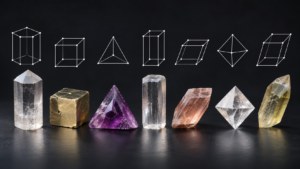
Have you ever wondered why some crystals form perfect cubes, whilst others form 6-sided pyramids or lumps with no clear shape? Whilst they are undeniably beautiful, there is a strict order to the way atoms are arranged inside of them which causes these crystals to grow in these particular ways.
The hidden structure is displayed by the shape of the mineral and explains why amethyst, pyrite and quartz are so unique. So, what are these different structures called, and how are the cubic, hexagonal, trigonal and other systems different? Let’s explore the fascinating science of crystal systems!
What Is a Crystal System?
A crystal system is a classification of crystalline material based on the symmetry of the crystal structure and the relationships between crystallographic axes.
Think of any crystal as a miniature architectural model made of atoms, and this structure repeats itself constantly, in a pattern, forming what we call unit cells.
These patterns in nature can form different internal structures which in turn give rise to different crystalline forms.
There are seven crystal systems, including:
- Cubic
- Tetragonal
- Orthorhombic
- Hexagonal
- Trigonal
- Monoclinic
- Triclinic
Systems can be differentiated from one another by their characteristic symmetry. Different arrangements of angles and lengths make up the basic building blocks of these crystal structures.
And most importantly, a crystal structure does not necessarily dictate its outward form, since crystals are shaped by their environment in unique ways depending on the space they occupy, temperature, and other factors.
1. Cubic Crystal System: The Beauty of Symmetry
What distinguishes this system is its 3 equal axes that intersect at right angles. The cubic system (also known as isometric system) is simple to understand due to its three axes being equal in length, and intersecting each other at 90-degree angles. This system creates wonderful shapes formed by symmetry.
Common elements of this group are:
- Pyrite
- Fluorite
- Halite
- Garnet
You can spot pyrite (also known as fool’s gold) wherever you look in the wilderness. It often appears as cubes, with metallic blue, while fluorite (calcium fluoride) can often be fond in cubes in fluorite ore deposits. Halite, or rock salt, is another common example of minerals that appear in cubic form.
It’s easy to believe that all cubic minerals are cubes, but that’s not actually the case. Minerals of this system can take different shapes, depending on the formation process, including octahedral forms.
2. Hexagonal Crystal System: Six-sided crystals
This system includes hexagonal crystals. Unlike the isometric system described above, the hexagonal system has a six-fold axis of symmetry.
In hexagonal unit cells, there are two horizontal axes that are of equal length and intersect at 120 degrees, while a vertical axis is perpendicular to the plane of the former two and has a different length.
Common elements of this group are:
- Beryl
- Apatite
- Some zinc minerals
Beryl is recognizable with its six-sided prism. This mineral includes popular precious stones like emerald, or aquamarine, but those are only special cases as they are usually found in distinct hexagonal crystals.
3. Trigonal Crystal System: Threefold Natural Harmony
What distinguishes this system is its three-fold symmetry axis. Sometimes called the rhombohedral system due to the structure of its unit cells, this crystal system is actually similar to hexagonal system. In fact, minerals that belong to this system often have very similar structures to some of its hexagonal counterparts, but have 3-fold axis of symmetry rather than 6-fold.
Common elements of this group are:
- Quartz
- Calcite
- Corundum
Quartz is one of the most familiar examples of a trigonal crystal system. The most common type can form beautiful six-sided prisms with pointed ends, but naturally occurring quartz can sometimes have a massive chunky form as well. Many people associate this mineral with its vitreous color and beauty, but it can occur in nature in a variety of colors with distinct patterns on the surface. Calcite is also found in a wide variety of formations, while corundum is the name for the mineral family that includes ruby, sapphire, and other precious stones.
One thing to note, however, is the fact that a trigonal crystal system is not necessarily trigonal in appearance. These terms are not interchangeable, and the distinction between crystal systems is based on an internal structure, not the number of visible sides.
4. Tetragonal Crystal System: Four-fold symmetry
This crystal system has a similar structure to the cubic system, except it’s been stretched vertically to appear closer to an elongated cube.
The tetragonal system is similar to the cubic system, but with four-fold axis symmetry and different ratios between its axes.
Common elements of this group are:
- Zircon
- Rutile
- Some cassiterite minerals
Tetragonal minerals can have square cross-sections as well as elongated forms. Zircon, which is cherished by collectors and jewelers, is one of the most common minerals of this group.
5. Orthorhombic Crystal System: Three different dimensions
This system contains crystals that possess three unequal axes that intersect at right angles. Orthorhombic crystals share similarities with tetragonal and cubic systems, but with a different ratio of length between the three axes.
Common elements of this group are:
- Topaz
- Olivine
- Barite
Topaz is a precious mineral that is valued both for its clarity and a wide range of colors. It can be often found in nature, in the form of large crystals that are highly sought after by jewelers and miners alike. Olivine is another valuable mineral, which has been found to be common in both Earth’s mantle and in some volcanic rock formations. Barite has a wide range of applications, including industrial uses such as radiography.
The orthorhombic crystal system, in turn, encompasses a wide range of minerals that all share the characteristic of having three different but mutually perpendicular axes. A crystal does not necessarily have to look cubic to belong to this system, due to its elongated appearance.
6. Monoclinic Crystal System: Different angles
A monoclinic crystal, unlike the orthorhombic system outlined above, only has two axes that intersect at 90 degrees.
Common elements of this group are:
- Gypsum
- Malachite
- Orthoclase
Gypsum is a fairly common mineral formed in nature in a range of formations from long, slender crystals to large ore blocks. Malachite is a beautiful mineral that is popular with collectors for its deep green coloration and unique patterns. Orthoclase is a mineral commonly found in rocks, and belongs to the broader family of feldspars.
These three examples illustrate the fact that a mineral’s color, structure, and chemical composition all determine its characteristics besides the crystal system.
7. Triclinic Crystal System: Beauty without right angles
The crystal system that has the least constraints of any other is the triclinic system. All three axes are of unequal length, and the angles between them are different.
Common elements of this group are:
- Turquoise
- Kyanite
- Some feldspar minerals, including plagioclase
Kyanite is interesting in that its strength varies depending on the direction of measurement – that is, it has anisotropic properties. The minerals of this system can sometimes look very different from regular crystals. A common example of a triclinic mineral is the turquoise, which has an unusual pattern of colors on surface of the stone.
Why Do Crystal Systems Matter?
Crystal systems help mineralogists classify crystalline substances. Understanding these crystal systems is key when trying to classify different types of minerals. Often the internal structure of a mineral will affect how it behaves mechanically and optically. This knowledge of crystal structures and their properties are used across many industries such as materials science, electronics and engineering. By knowing the properties of certain types of crystals humans can create increasingly complex devices.
For a crystal collector, this information might be important to further differentiate between various minerals. After all, finding out that a particular specimen of fluorite does not actually belong to the cubic system and is not a perfect cube might be disappointing, so this knowledge can help you distinguish minerals with greater accuracy. But at the end of the day, it’s important to remember that crystal system is only a small factor of mineral identification, and other considerations must be taken as well.
Unveiling The Hidden Structures of Crystals
From sharp pyrite cubes, to exquisite beryl hexagons and interesting quartz shapes, all crystals tell a unique story about the structure of atoms within them.
The seven crystal systems introduce us to a marvelous world of mineral physics, chemistry, and more importantly for collectors everywhere, a deeper appreciation of the ordered structures of some of the most common minerals to be found in nature and in the world around us.
