
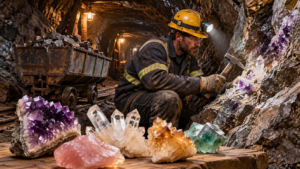
Have you ever fondly wondered how the dazzling amethyst cluster or fascinating clear quartz crystal got that way? Before finding its way into a glass showcase at a museum or a jewelry boutique display, a crystal may have spent millennia buried underground.
Finding crystals is not as simple as digging a hole. Mining involves geology, exploration, equipment, and patience. Some crystals are mined from underground, while others can be found in rocky sediment or in the hollow chamber of a volcano.
How Are Crystals Mined and Processed?
So how exactly does mining work and what is involved in collecting a crystalline specimen to put on display? Read on to find out how we get the crystals hidden gems of the earth.
1. What are the conditions for crystal formation underground?
Before a crystal can be dug out, it needs to form somewhere first. Crystals typically form as a result of mineralization which occurs when the right chemical ingredients are found within a favorable temperature and density.
Each element that bonds with another takes on unique properties. Some notable minerals that can contain desirable crystals include:
Pegmatites – some of the largest crystals ever discovered come from these medium- to coarse- grained igneous rocks. Pegmatite is a significant source of quartz, tourmaline, beryl, and feldspar.
Hydrothermal veins – these are mineral deposits formed when mineral bearing fluids run through fissures in other rocks. The movement and pressure of the fluid causes minerals to crystallize within the hollow spaces.
Geodes and volcanic rocks – these rocks contain pockets of minerals which would later become the desirable quartz crystals like amethyst.
River beds or sediment deposits – these are the remnants of the minerals which were broken off from the parent rocks. The broken fragments would eventually be laid down in streams and rocks as gravels and sediment.
Each place has its own unique characteristics. Knowing where these characteristics can be found means finding a crystal formation. It can mean long months of exploration for a mining company to find the right spot that has the right qualities of minerals, crystals, and even the absence of dangerous elements that can compromise a crystal’s structural soundness.
2. How do miners find a crystal formation?
A lot of crystal mining goes into the planning stage. Miners, geologists, even land surveyors can work together to find a desirable deposit. Existing mines can be studied. Rock formations can be observed from a distance. Samples can be taken to study the density, weight, and other properties. Some companies may even have to use high tech methods to find the minerals.
After determining that a particular location has the right properties, a small-scale dig can be made to check if there are crystals worth extracting.
Now here is a surprising piece of information: for mineral specimen mining, the most desirable location may not be the place with the most quantity of crystals. It may be possible that a particular deposit will have more quartz material, but the crystal structures would be undesirable and unfit for display.
The type of deposit to be mined largely determines the kind of mineral that can be retrieved. Industrial mining works to retrieve as much usable material as possible. Specimen mining tries to get the most desirable crystal structure without sacrificing the integrity of the specimen itself.
3. How are crystals extracted from the earth?
There is no single way to get crystals from the ground. It will mainly depend on the location of the deposit and the structural integrity of the mineral itself.
Underground mining – if the deposit is far below the surface, the miners will have to work in shafts or tunnels to get what is inside. This is a common method used when the mineral itself is large and desirable. The miners would use tools to extract the crystal. It is a dangerous environment due to a lot of environmental factors but that only makes it more rewarding once that desirable chunk of quartz is uncovered!
Open-pit or quarries – this is also similar to a quarry except that it works for minerals other than construction materials. Large chunks of rocks are removed from the earth to get to the minerals and crystal deposits underneath. Miners can sift through the rock debris for any desirable veins for the quartz crystal, tourmaline, or sapphires.
Placer – some miners use running water to separate heavy minerals that came from weathered material, rocks, and ores. This method is especially useful for gold, diamonds, and other precious minerals.
No matter the method needed to separate the crystals from the ores, the main goal is to determine where the mineral is and get it in a way that preserves it for future display.
4. The art of crystal extraction.
Finding a deposit of amethyst crystals may be exciting but getting it up and out of the ground may be painstaking.
Picture an amethyst cluster with nice pointy shapes at the very heart of an opened-up mineral formation. It appears solid, but the tip of the crystal formation is thin, it has a number of fractures running across it, and the individual crystals are weakly connected. A single strike can cause a whole branch of clustered amethyst crystals to fracture.
Specimen miners work painstakingly to get around the cluster of minerals that contains the desired quartz crystal. They might use geological hammers and other tools to free the crystal. Some commercial specimen miners may use machines to extract big chunks of mineral and then go over the deposit with the tools. The method is largely dependent on the situation of the crystal and whether it is embedded on solid rock or inside a pocket of space.
Sometimes miners take rocks or minerals surrounding a desirable crystal just so they can save it for future processing. Other times, some crystals just appear to come from some kind of natural formation, but once everything has been disintegrated, it still does not turn out to be a desirable specimen.
That’s the thrill of a crystal mining: the unknown.
5. What do miners do with the crystals after extraction?
It’s time to process the rock that has taken months of careful excavation just to uncover a few interesting pieces.
This may largely depend on what kind of crystal has been uncovered. Cleaning involves carefully taking the crystal, brushing the undesired materials, and maybe soaking it with other materials if the material allows for it (some crystals would simply dissolve when exposed to water). Identifying the specimen involves taking notes on its properties and appearance.
Trimming involves carefully removing whatever unwanted materials on the crystal so as to reveal the desired formation. Specimen grading or quality assessments are done to determine what kind of product the crystal can become, with options including leaving it as-is, carving it into a more desirable formation, and subjecting it to grinding and polishing to reveal exotic features of the mineral.
Not everything goes into gem and mineral shows. Not every crystal can be presented the way it came from the ground, but it does not mean they are not fit for purpose. Some crystals may not be desirable on their own, but they can be cut to reveal interesting patterns and formations.
It is important to remember that although cleaning and trimming is a part of the process, it is not always about getting a nice polished crystal. Some minerals have their own natural aesthetic which may have gone under the hands of a professional mineral preparation service.
6. Is every crystal mined in the same way?
Absolutely not, because not every crystal grows the same way.
While amethyst crystals commonly appear in geodes, clear quartz is commonly found in deposits. Tourmaline crystals may be found in pegmatite deposits, while emeralds take years to form in the right kinds of environment (the specific kind of beryl which carries trace elements of chromium and vanadium for it to have that bright green color).
Some miners find desirable crystal specimens embedded in a rocky sediment while other miners have to dig through tons of material just to find a single branch of quartz. The techniques required to extract crystal from these different deposits would obviously be different and the final appearance of the crystal will vary by case.
This means that two crystals of similar size can be incredibly different in price, quality, and general appeal.
7. Why responsible mining matters.
Although crystals are natural elements, irresponsible or unregulated mining can wreak havoc in the landscape. Excavating a mountain or a hill can rob that particular area of flora and natural vegetation. It may rob wildlife of their habitat. Water sources, surface or underground, can also be affected by the waste material of mining operations. Poorly regulated mining companies also puts miners at risk.
It will be best not to buy the crystals from an irresponsible company to begin with. Ask them about their provenience and how they got a hold of that crystal in the first place. Reputable companies will be able to explain it to you.
Some companies may not have the information to trace the history of the crystal and may only be able to tell you how the crystal came to be processed or sold.
Either way, it is important to be responsible for what you do as a prospective crystal enthusiast.
Final thoughts: Every crystal has a story.
From a crystal deposit in the deep earth until the day it shines as part of a rock display or jewelry boutique window display, a crystal has gone through a difficult journey. Some crystals grow attached to mineral deposits and structures below the ground for thousands of years. Some of them are even found in deposits that the sea has shaped and molded for years. Knowing about the crystal environment and formation is essential to finding and extracting the crystal you want.
Next time you look at that nicely colored crystal in the store, think of how the environment around it shaped it up until you see it in all its glory.
