
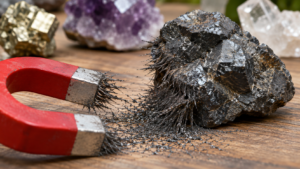
Imagine you have a plain looking black stone. If you bring a common magnet close to it nothing seems to happen. However, suddenly it will move!
For a moment it might seem magical. However, there is a scientific explanation behind why this stone is attracted to the magnet based on its atomic structure.
Most crystals won’t have any noticeable reaction to a common magnet. However, some minerals are naturally magnetic and will be attracted to a magnet. These minerals have been fascinating us for centuries, helping to shape navigation history and giving clues to Earth’s ancient history.
What minerals will have this strange property and why? How can you test your own mysterious stone? Take a look into the world of magnetic crystals!
What Makes a Crystal Magnetic?
All minerals are made up of atoms. Within those atoms are electrons. These electrons have a property called spin. Depending on how the magnetic components interact with each other and are positioned within the atom, the material will have a strong, weak or very weak reaction to an external magnet.
Strongly magnetic minerals will have strong interactions between their atoms. For example, magnetite is a ferrimagnetic mineral. This means that the opposing magnetic components do not fully cancel each other out and will have a high level of magnetism.
Some minerals will be paramagnetic meaning they will have a weak attraction to an external magnetic field. Others will be diamagnetic meaning they will have a weak reaction against the external magnet.
This is why two seemingly identical stones can have totally different reactions.
Magnetic Minerals and Their Properties
1. Magnetite – The Magnetic Star!
If there was a magnetic mineral celebrity then magnetite would be a good candidate!
Magnetite (Fe 3O 4) is an iron oxide found in many rock types. It is generally black or dark grey and can sometimes have a metallic or dull lustre. Although it may not look very exciting, it can be very magnetic!
Bringing a suitable magnet close to a sample will show a clear magnetic attraction. Magnetite is also quite a heavy mineral, so the sample may be heavier than expected. However, there is an interesting type of magnetite called lodestone. This type of magnetite is strongly naturally magnetized and acts as a permanent magnet.
Long before scientific equipment, humans discovered that lodestone would attract iron and affect magnetic needles. This knowledge was eventually used in China to create early compasses using magnetic direction finding. This helped change how people navigated unknown areas of land and water.
Lodestone still makes a great collectible mineral due to showing a amazing natural phenomena without needing batteries, wiring or any equipment.
It is not just the appearance. Being able to hold a naturally magnetized stone gives a real tangible connection between geology and physics and history.
2. Pyrrhotite – A Metallic Mineral with a Magnetic Twist!
This mineral is very different to magnetite. It is generally bronzey or brown-bronzey in color.
It generally has a composition of Fe 1-xS. This affects how magnetic the mineral can be.
Some samples of pyrrhotite will be noticeably magnetic. However, others will only have a weak reaction. This can depend on the composition and crystal structure.
This can be a great reminder that not all minerals will be strongly magnetic! Even though they are from the same mineral type, they may have different reactions.
Its metallic appearance makes it an interesting mineral to add to a collection. Especially if it can be shown alongside magnetite to show how different the properties of iron bearing minerals can be.
3. Hematite – An Iron Mineral That Can Be Misleading!
Hematite is another iron oxide mineral. This has a chemical composition of Fe2O3. It can come in many forms including metallic grey, dark grey, black and reddish brown. This makes it a common mineral to see in mineral collections and decor.
However, unlike strongly magnetic magnetite, hematite generally won’t have the same properties. Natural hematite will generally not have a strong reaction to a common magnet. However, some may have a weak attraction.
A useful way to identify hematite is by using a streak test. If done correctly on an unglazed porcelain streak plate hematite will generally leave a reddish-brown streak. Whereas magnetite will generally leave a black streak.
This can be useful to know when buying “magnetic hematite” jewelry. Some highly magnetic items are not actually hematite and will have other magnetic materials or fake items.
Therefore, it is important to take note of the name, color and magnetic properties.
4. Maghemite & Ilmenite – Minerals To Find!
Maghemite is a similar mineral to magnetite. It is another iron oxide mineral and is generally brown-black or reddish brown. It can form from the oxidation of magnetite. Like magnetite it can be highly magnetic.
Ilmenite is an iron titanium oxide mineral with the composition FeTiO3. It is generally dark grey or black and is an important source of Titanium. This metal is used in many applications including aerospace engineering and industrial manufacturing.
Unlike magnetite and maghemite ilmenite will generally only be weakly magnetic. This can depend on the composition and impurities.
This shows that just because a mineral contains iron does not mean it will be highly magnetic. The atomic structure plays a large role.
Why Don’t Amethyst, Quartz etc. Have The Same Reaction?
Crystal Healing Set – Amethyst Cut Base, Clear Quartz Point & Raw Rose Quartz (Home Decor) (Etsy Italia)
If you have a collection of amethyst, rose quartz, clear quartz or fluorite you may have tried bringing a magnet close to your favorite stones.
Most of the time nothing will happen.
Quartz is a diamagnetic mineral meaning it will have a weak reaction to an external magnet. Amethyst is a type of quartz that has a purple color. This color is due to trace impurities and irradiation. Generally, it will not have the strong attraction of magnetite.
Even if the mineral contains iron, it may not be very magnetic. The interaction between the electrons and atomic structure will determine this.
Sometimes stones that aren’t very magnetic can have small amounts of magnetic mineral inclusions. This can give a noticeable reaction.
This is one reason why there are multiple ways to identify minerals.
How To Test Your Stone At Home!
If you want to start testing your mineral collection you will need a small permanent magnet.
Place your stone on a clean, steady surface. Bring the magnet close to the stone. Don’t slide the magnet across the surface as this can cause scratches to the softer minerals or polished surfaces. See if there is any reaction.
If there isn’t any reaction try using a stronger magnet. Try keeping the magnet close to the stone. If you have a sample of magnetite compare the reaction.
Remember that just because there was no reaction does not mean it isn’t magnetic. Some minerals will only be weakly magnetic and therefore may not react to a common magnet. They can also have small amounts of magnetic inclusions.
This method can’t identify what the mineral is. You may need to use other methods including hardness, streak, density and crystal structure.
Make sure to keep the strong magnets away from sensitive electronics and magnetic storage. Also make sure not to scratch any valuable samples.
Magnetic Minerals – Small Clues About Earth’s Ancient History!
Geologists study the magnetic properties of rocks. This area of study is called paleomagnetism. During cooling, certain rocks can lock in the direction of the Earth’s magnetic field using magnetic minerals.
Scientists have discovered evidence of changes to the Earth’s magnetic polarity and movement of tectonic plates by studying these patterns. For example, the magnetic patterns in rocks on the ocean floor helped provide important evidence for sea floor spreading.
U.S Geological Survey
It is incredible to think that tiny mineral inclusions can give clues about geological events that happened millions of years ago!
A seemingly boring stone can actually have clues about the history of our planet!
The Surprising Side Of Crystals!
Magnetic minerals really show how fascinating nature can be. They combine geology, chemistry, physics and history.
From strong attractions of magnetite, to varying reactions of pyrrhotite and subtle properties of hematite each mineral has their own story to tell.
You don’t need a professional lab to start discovering these properties. Using a simple magnet, curious mind and some samples you can turn a normal afternoon into a mini science experiment.
Next time you are looking through your crystal collection take a look at the minerals you have. You might be surprised to find a mineral with an unexpected reaction, interesting geological history or properties you didn’t know about!
Explore more about natural crystals and their properties at Crystal Dreams.
