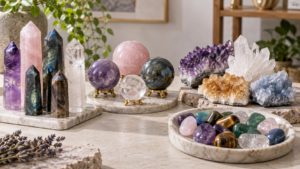
 Crystal Towers, Spheres, Clusters & Tumbled Stones
When shopping for crystals, choosing the mineral is only half the decision. The same crystal can appear as a tower, sphere, cluster, tumbled stone, palm stone, freeform, or raw specimen, and each form offers a very different buying experience.
A large crystal sphere may look impressive online but require a secure stand and plenty of display space. A tower fits neatly on a desk or shelf but needs a stable base. A natural cluster can become a striking collector piece while also being more fragile and difficult to clean. A tumbled stone may have less visual impact, yet it is affordable, portable, easy to handle, and practical for someone buying their first crystal.
So when comparing crystal towers vs spheres vs clusters, there is no single form that is best for everyone.
The right choice depends on where you will keep the crystal, how often you will handle it, how much space you have, your budget, whether you want to carry it, and how much maintenance you are comfortable with.
This guide focuses on those practical differences so you can choose a crystal form that fits the way you actually plan to use it.
Why Does Crystal Form Matter?
Crystal form affects much more than appearance.
It can influence:
- Price
- Weight
- Display requirements
- Portability
- Handling comfort
- Fragility
- Storage
- Cleaning
- Amount of processing
- Suitability for gifting
For example, a tumbled Amethyst and an Amethyst sphere may originate from the same type of mineral material, but they are very different products.
One can fit in your pocket. The other may function primarily as a decorative display piece.
That is why you should decide what you want from the crystal before deciding which shape looks best.
Crystal Forms at a Glance
| Crystal Form |
Best For |
Space Needed |
Portability |
Typical Buying Consideration |
| Tumbled Stone |
Beginners, carrying |
Very Low |
Excellent |
Size and finish |
| Palm Stone |
Handling, meditation |
Low |
Very Good |
Comfort and weight |
| Tower |
Desk, shelf, display |
Moderate |
Low |
Base stability |
| Sphere |
Decorative display |
Moderate |
Low |
Stand and rolling risk |
| Cluster |
Collecting, statement display |
Medium–High |
Poor |
Fragility and condition |
| Raw Specimen |
Collecting, natural appearance |
Varies |
Varies |
Formation and condition |
| Freeform |
Décor, display |
Moderate |
Low |
Stability and polish |
This comparison is a better starting point than assuming one shape is inherently more desirable.
What Is a Crystal Tower?
A crystal tower is a shaped piece with a vertical body, pointed top, and usually a flat base.
Towers may be made from:
- Quartz varieties
- Fluorite
- Jasper
- Agate
- Calcite
- Labradorite
- Other materials suitable for shaping
Because towers are cut and polished, their final appearance depends partly on craftsmanship.
Why Buy a Crystal Tower?
Crystal towers are especially practical when you want a piece that:
- Has noticeable vertical presence
- Fits on a desk
- Uses less horizontal space
- Works on a shelf
- Displays internal patterns clearly
- Looks refined and intentional
A tower can provide greater visual impact than a tumbled stone without requiring as much surface area as a large cluster.
What Should You Check Before Buying a Tower?
Do not judge a tower from the front photograph alone.
Check:
- Height
- Width
- Weight
- Base
- Surface finish
- Chips
- Point condition
- Internal fractures
- Overall stability
The base is particularly important.
A tall, narrow tower with an uneven base may look impressive but become frustrating if it tips over easily.
If the seller provides dimensions, consider both height and width, not height alone.
Are Taller Crystal Towers Better?
Not automatically.
A taller tower can have more visual presence, but it may also:
- Cost more
- Weigh more
- Require additional clearance
- Be easier to knock over
- Need a deeper shelf
For a small desk, a compact tower may be the smarter purchase.
For a dedicated display shelf, a larger tower might make sense.
Buy according to your space rather than assuming height equals quality.
What Is a Crystal Sphere?
A crystal sphere is shaped and polished into a rounded form.
Spheres can be particularly attractive because polishing may reveal:
- Internal patterns
- Banding
- Color variation
- Inclusions
- Optical effects
They also look visually different depending on viewing angle.
Why Buy a Crystal Sphere?
A sphere works particularly well as:
- A decorative centerpiece
- Shelf décor
- A collector piece
- A meditation-room object
- A gift
Unlike a tower, a sphere does not have one obvious “front.”
That can make it attractive for open shelving or displays that are visible from several directions.
Crystal Spheres Need a Stand
This sounds obvious, but it is an important buying consideration.
A polished sphere can roll.
Before buying one, check whether:
- A stand is included
- You need to purchase a stand separately
- The stand can support the sphere’s weight
- The display surface is level
- The sphere will be protected from falling
Never assume a heavy sphere is safe simply because it feels substantial.
A fall can damage:
- The sphere
- Furniture
- Flooring
- Nearby objects
For larger spheres, display stability should be part of the purchase decision.
Does Sphere Size Matter?
Yes.
A small sphere can work on:
- A desk
- Small shelf
- Bedside table
A large sphere may require:
- A substantial stand
- Strong shelving
- More surface area
- Greater distance from edges
Check actual diameter rather than relying on close-up photographs.
What Is a Crystal Cluster?
A cluster is a natural formation in which multiple crystal points or crystals occur together.
Unlike towers and spheres, clusters are generally appreciated for their natural structure rather than a standardized shape.
A cluster may show:
- Multiple terminations
- Different crystal sizes
- Matrix material
- Natural growth patterns
- Mineral combinations
- Irregular surfaces
This makes clusters especially appealing to people who enjoy crystals as natural specimens.
Why Buy a Crystal Cluster?
Clusters work particularly well for:
- Collector displays
- Large shelves
- Living-room décor
- Dedicated crystal cabinets
- Natural interior styling
Each cluster can be highly individual.
Even two specimens from the same mineral deposit may have very different shapes and formations.
Clusters Require More Care
The same natural features that make clusters visually interesting can make them less practical.
They may contain:
- Thin points
- Fragile terminations
- Narrow spaces
- Matrix
- Sharp surfaces
- Difficult-to-clean crevices
A cluster is generally not something you would casually throw into a bag or move around every day.
It usually makes more sense as a stable display specimen.
What Should You Check Before Buying a Cluster?
Online photographs are particularly important for natural clusters.
Look for:
- Multiple viewing angles
- Broken points
- Fresh chips
- Repairs
- Matrix stability
- Dimensions
- Weight
- Overall formation
If you are paying a premium for a specimen’s natural structure, condition matters.
What Is a Tumbled Stone?
Tumbled stones are small pieces of mineral material that have been smoothed and polished, usually through a tumbling process.
They are among the most accessible crystal forms.
Why Buy Tumbled Stones?
They are:
- Compact
- Affordable
- Smooth
- Easy to carry
- Beginner friendly
- Easy to store
- Simple to gift
For someone who wants to explore several different minerals without spending heavily on large specimens, tumbled stones are often a practical entry point.
Tumbled Stones Are Ideal for Small Spaces
Not everyone has room for a shelf filled with towers and clusters.
Tumbled stones can be kept in:
- Small trays
- Pouches
- Boxes
- Desk drawers
- Meditation areas
They are particularly useful for apartments, dorm rooms, workspaces, and minimal interiors.
What Should You Check When Buying Tumbled Stones?
Look at:
- Approximate size
- Stone identification
- Surface polish
- Chips
- Natural variation
- Whether you receive the exact piece shown
- Treatment disclosures where relevant
Because tumbled stones are often sold in larger quantities, some sellers use representative photographs rather than photographing every individual piece.
Read the product description carefully.
What Is a Palm Stone?
Palm stones are polished pieces shaped to fit comfortably in the hand.
They are usually larger than standard tumbled stones but smaller and easier to handle than many decorative specimens.
Why Choose a Palm Stone?
Palm stones are particularly practical for:
- Meditation
- Reflection
- Journaling
- Desk use
- Comfortable handling
If you like physically holding a crystal, a palm stone can make more sense than a tower or cluster.
Palm Stone vs Tumbled Stone
| Feature |
Palm Stone |
Tumbled Stone |
| Size |
Medium |
Small |
| Hand Comfort |
Excellent |
Good |
| Pocket Carry |
Good |
Excellent |
| Meditation |
Excellent |
Good |
| Price |
Usually higher |
Usually lower |
| Display Impact |
Moderate |
Low |
| Beginner Friendly |
Excellent |
Excellent |
Neither is universally better.
Choose based on whether handling comfort or portability matters more.
What Is a Crystal Freeform?
A freeform is a polished crystal shaped to follow the material rather than conforming to a strict geometric shape such as a sphere or tower.
Freeforms can reveal:
- Patterns
- Color zones
- Inclusions
- Natural-looking outlines
They often sit somewhere between natural specimens and highly standardized polished shapes.
Why Buy a Freeform?
A freeform can be a good choice when you want:
- A polished surface
- Unique shape
- Strong decorative presence
- Stable shelf display
- More individuality than a standardized tower
Check that the base is stable if the piece is designed to stand upright.
Tower vs Sphere: Which Should You Buy?
Choose a tower if:
- You have limited horizontal space.
- You want vertical display.
- You like geometric shapes.
- You need something for a desk or narrow shelf.
Choose a sphere if:
- You want a centerpiece.
- You enjoy viewing patterns from different angles.
- You have room for a proper stand.
- You prefer rounded decorative objects.
From a practical standpoint, neither is better.
Your available space may decide for you.
Tower vs Cluster: Which Is Better?
Choose a tower if you want:
- A polished appearance
- Predictable shape
- Easier dusting
- More compact placement
Choose a cluster if you want:
- Natural formation
- Collector appeal
- Organic texture
- A unique statement specimen
The cluster generally requires more careful handling, while the tower is easier to integrate into everyday décor.
Sphere vs Cluster: Which Is Better?
A sphere offers:
- Smooth finish
- Symmetry
- Easier surface cleaning
- Refined décor
A cluster offers:
- Natural structure
- Individuality
- Geological interest
- Organic visual character
If your main interest is mineral collecting, the cluster may be more interesting.
If your priority is polished interior décor, the sphere may fit better.
Tumbled Stones vs Large Display Crystals
This comparison largely comes down to practical use vs visual impact.
Choose Tumbled Stones When:
- Budget matters.
- You’re a beginner.
- You want portability.
- You have little display space.
- You want to explore several minerals.
Choose Larger Display Pieces When:
- You already know what you like.
- You have dedicated space.
- Décor matters.
- You collect specimens.
- You want a focal piece.
There is no reason a beginner needs to start with large crystals.
Does Crystal Shape Change Its Value?
Shape can affect price because shaping requires:
- Labor
- Equipment
- Material removal
- Polishing
- Finishing
- Skill
A sphere, for example, may require substantial material to be removed before the final rounded form is achieved.
But shape is only one pricing factor.
Mineral rarity, size, color, quality, formation, condition, and demand also matter.
For a deeper breakdown of pricing, Crystal Dreams’ Why Do Crystal Prices Vary So Much? A Buyer’s Guide to Quality, Size & Rarity explains why apparently similar pieces can have very different price tags.
Does Crystal Shape Change Its Energy?
Different spiritual traditions and modern crystal practices may assign symbolic meanings to particular shapes.
However, there is no scientific evidence establishing that a crystal becomes medically or physically more effective because it has been shaped into a tower, sphere, or another form.
If shape has personal significance within your spiritual practice, that can still influence which object you enjoy using.
From a buying perspective, however, prioritize:
- Material
- Authenticity
- Physical condition
- Intended use
- Size
- Durability
- Price
rather than paying a large premium based solely on claims that one shape is universally “more powerful.”
Raw Crystal or Shaped Crystal?
If you are still deciding whether you want a natural specimen or processed piece, Crystal Dreams’ Raw vs Polished Crystals: Which Should You Buy and Why? covers that comparison separately.
In simple terms:
Raw: natural formation and geological character.
Polished: smooth handling and refined appearance.
Shaped: specific geometry and predictable display characteristics.
That distinction can make shopping much easier.
Which Crystal Form Is Best for a Beginner?
For most beginners, a tumbled stone or palm stone is the simplest starting point.
Why?
Because you can learn which minerals you actually enjoy before investing in:
- Large towers
- Spheres
- Clusters
- Collector specimens
Once you know which stones interest you, you can upgrade to larger or more decorative forms.
Which Crystal Form Makes the Best Gift?
If you do not know the recipient well, consider:
Tumbled Stone
Affordable and simple.
Palm Stone
Personal and easy to handle.
Small Tower
Visually impressive without requiring excessive space.
Sphere
Attractive gift when a stand is included.
Clusters can also make excellent gifts, but their irregular size and fragility make them better suited to someone who already enjoys collecting crystals.
Consider Your Space Before Buying
Before ordering a decorative crystal, measure the intended location.
Check:
- Shelf height
- Shelf depth
- Surface width
- Weight capacity
- Distance from edges
- Nearby traffic
- Children or pets
A beautiful crystal that cannot be safely displayed becomes an inconvenient purchase.
Consider Cleaning and Maintenance
Different forms accumulate dust differently.
Easier to Dust
- Spheres
- Palm stones
- Tumbled stones
- Polished freeforms
Potentially More Difficult
- Clusters
- Raw specimens
- Complex carvings
But remember that the appropriate cleaning method depends primarily on the mineral, not its shape.
Do not automatically wash a crystal simply because its surface is difficult to clean.
For independent mineral and gemstone information, the Gemological Institute of America Gem Encyclopedia can help you research the properties of specific gemstone materials.
Which Crystal Form Gives You the Best Value?
“Best value” depends on your purpose.
| If Your Priority Is… |
Consider Buying… |
| Lowest-cost entry |
Tumbled Stone |
| Pocket portability |
Tumbled Stone |
| Comfortable handling |
Palm Stone |
| Desk display |
Small Tower |
| Refined décor |
Sphere or Freeform |
| Natural display |
Cluster |
| Mineral collecting |
Raw Specimen or Cluster |
| Small-space décor |
Tower |
| Statement piece |
Large Cluster, Sphere or Freeform |
| Beginner gift |
Tumbled, Palm Stone or Small Tower |
This prevents you from paying for features you do not actually need.
Questions to Ask Before Buying Any Crystal Form
Where will I keep it?
A pocket, desk, shelf, display cabinet, or meditation area?
How much space do I have?
Check actual dimensions.
Will I handle it frequently?
If yes, smooth and compact forms may be more practical.
Is it stable?
Especially important for towers, spheres, and upright freeforms.
How fragile is it?
Natural clusters and soft minerals may require additional protection.
How much maintenance am I comfortable with?
Intricate specimens can be more difficult to dust and clean.
Is the crystal genuine?
Shape alone tells you nothing about authenticity.
If you’re unsure about the underlying material, Crystal Dreams’ guide on How to Buy Authentic Healing Crystals can help you evaluate the crystal itself separately from its shape.
Is the price justified?
Compare mineral, dimensions, weight, quality, processing, and condition rather than shape alone.
Crystal Form Buying Checklist
Before checkout, confirm:
- Mineral: Clearly identified
- Form: Appropriate for your intended use
- Dimensions: Suitable for your space
- Weight: Practical for the location
- Stability: Safe to display
- Condition: No unexpected chips or damage
- Finish: Appropriate quality for polished pieces
- Fragility: Manageable for your household
- Care: You understand the mineral’s requirements
- Price: Reasonable for the material and processing
- Seller: Provides sufficient product information
Frequently Asked Questions
Are crystal towers better than spheres?
Neither is inherently better. Towers are compact and work well on desks and narrow shelves, while spheres provide a rounded decorative display and usually require a secure stand.
Are crystal clusters worth buying?
Clusters can be excellent purchases for collectors and natural décor because each formation is unique. However, they can be more fragile and harder to clean than polished forms.
What crystal form should a beginner buy?
Tumbled stones and palm stones are practical starting options because they’re affordable, easy to handle, compact, and require little display space.
Why are crystal spheres sometimes expensive?
Producing a sphere involves cutting, shaping, polishing, and removing material. Final price can also depend on mineral type, size, weight, quality, pattern, rarity, and craftsmanship.
Is a raw crystal better than a shaped crystal?
Not universally. Raw specimens preserve natural formations, while shaped crystals provide smoother surfaces, predictable dimensions, and different display options. Choose according to your intended use.
Conclusion
When comparing crystal towers, spheres, clusters, and tumbled stones, the best choice is not determined by which shape looks the most impressive or which one is marketed as the most powerful.
A tower is practical when you want vertical visual impact without using too much shelf space. A sphere works well as a polished centerpiece but requires a stable stand. A cluster preserves natural mineral formation and can become an impressive collector display, although it usually needs more careful handling. A tumbled stone offers affordability, portability, and simplicity, while a palm stone is particularly comfortable for handling and meditation.
Before buying, think about space, portability, stability, fragility, maintenance, price, and intended use.
If you’re still deciding between natural and finished material, read Raw vs Polished Crystals: Which Should You Buy and Why? If price differences are confusing you, continue with Why Do Crystal Prices Vary So Much? A Buyer’s Guide to Quality, Size & Rarity.
Together, those guides answer three different buying questions: which finish, why the price differs, and which form to choose—without repeating the same crystal-benefit content.
Explore Crystal Dreams for crystals, crystal jewelry, and educational resources to help you choose pieces that genuinely fit your collection, space, and intended use.

