
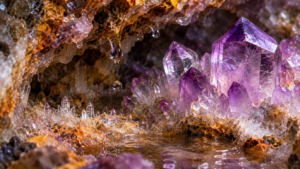
But have you ever wondered how nature creates so many different crystalline structures? Each mineral crystal, no matter how simple its geometric structure or the riotous colors in amethyst may startle, still has to have a scientific formation process taking place. Before crystals become the beautiful and sought-after items that we add to our mineral collection, they are formed underground within cavities in rock, underwater in veins or from salt water evaporation.
Understanding how these incredible structures are formed gives us an insight into nature and helps us appreciate the beautiful crystals we love.
How Crystals Are Formed
A solid is created with a chemical structure where atoms, ions and/or molecules are ordered. The particles will create a pattern that is repeated in 3 dimensions. The term for the pattern in which these materials are arranged is a lattice. Note that crystals have an ordered structure in three dimensions, making them distinct from materials that have an ordered structure in just one direction (like plastic).
The atoms and other particles in a mineral like quartz which is made up of silicon dioxide will form a particular pattern, unique to that mineral. But other minerals will dictate other structures, hence the differences in crystal structure and shape between diamonds, fluorite, calcite, and amethyst.
The outside structure of a mineral often suggests the lattice arrangement in its construction. Many crystals will have points that define their shape, or a cubic structure; others will have flat planes, others will possess a columnar structure. But these structures can only form when the conditions underground or under other environmental factors are precisely right.
A crystal’s lattice will form at a level too small to see, but each particle is contributing to a specific pattern which distinguishes that mineral. In fact, most types of minerals can be identified visually based on their structural properties.
Crystal Formation Basics for Nature’s Gems
The process of creating a crystal formation is called crystallization. While there are different ways that minerals will deposit and create crystals, the process always includes two basic steps: nucleation and crystal growth.
1. Nucleation – The Birth of a Tiny Crystal
In order for a crystal to form from solution, a tiny cluster of the crystalline substance has to form first and act as a seed for the new crystal formation. To use an example some of us may remember from chemistry class, let’s pretend you have a salt solution. You start adding mineral solution to the salt solution when the proper conditions are met and the two start to combine, forming larger structures. The new salts might form a tiny cluster, a nucleus, capable of being the core for a new crystal formation.
Nucleation can occur in solution or as another surface, such as on a thin piece of rock.
2. Crystal Growth – The Building of Greater Structures From Seeds
This is the process of the crystalline structures building off of the seed crystal, a process that makes use of the orderly pattern of the crystal lattice.
Crystals grow by the addition of atoms, ions, or molecules to the crystal lattice structure, which causes the crystal to increase in size.
The growth will take place based on several variables including the presence of the required material, temperature, and time. In the correct environment, a crystal may continue to grow and add additional atoms or molecules to its structure, forming a visible mineral. When the proper conditions fail or when the environment changes, further growth of the crystal can be arrested until such time as the environment again allows the growth to continue.
But creating new crystals isn’t simply a matter of placing the required minerals together and waiting. You need to have the environmental conditions in place, so that the elements necessary to the crystalline structure are available.
4 Different Means By Which Natural Crystals Are Formed
There are a number of ways that minerals can form underground or within the earth’s crust. But all formations have one underlying structure, determined by the atoms which make up the mineral.
1. Crystals Start in the Structures of Magma
Crystals form most frequently around magma underground. Melted rock tends to have a variety of elements present which can precipitate out of the solution to begin crystal growth and formation. But it can also mix with minerals present below ground, precipitating and forming new minerals.
Magma consists of melted minerals which can crystallize when the right environmental factors are present. Not all minerals can crystallize at the same heat, meaning that different minerals will be present in different magma structures.
The rate at which magma cools will play a large role in determining mineral structures. Faster cooling will prevent crystal formation from occurring. Slower cooling will allow crystals to form.
If there is slow cooling of the magma underground and sufficient material then pretty, big crystals can form. However, if the magma makes it up to the surface and turns into lava then the crystals will form quickly so they are usually small. If the cooling is even faster like when the lava becomes volcanic glass then the crystals will not form at all.
This is an example of how geological factors and time can affect the resulting structures.
2. Minerals in Water Can Create New Crystal Formations
Water does funny things with minerals. As water travels through underground crevices or aquifers, it can pick up minerals in solution and bring them along until the environmental conditions change and the minerals are deposited. Water can play a vital role in crystal formation.
When water is heated (by magma below ground for example), it can pick up minerals which then get deposited when the water cools.
Or a deposit of minerals may be forced (with the water under high pressure) down through crevices, creating a mineral rich cave or underground room (a geode). These mineral deposits can then take on a crystalline structure. Minerals that may take this method of formation include quartz, calcite, fluorite, amethyst, and many others.
This example shows how the same environmental conditions (heated water) can create a whole range of different minerals.
3. Similar to Water are the Processes of Evaporation
Not all of the processes by which crystals are formed, take place underground. Another process forms crystals in the deposits of salt lakes or evaporated shallow seas.
Evaporated water will leave behind the minerals dissolved in the water in a deposit. These can take beautiful crystalline structures if conditions are right. Rock salt or halite is one such deposit that takes the form of crystals. Gypsum is another.
Evaporation can be as simple as leaving a salt water solution to sit after you’ve added table salt to it. On the other hand, natural deposits can have far more complicated structures due to a range of dissolved minerals.
4. The Effect of Heat and Pressure on Existing Rock Creates Metamorphic Minerals
Crystallization can also take place through the effects of immense heat and pressure on existing minerals.
Without melting existing rock completely, changes at the granular level can result in crystals forming. These can include the growth of new minerals through the dissolving and reforming of existing minerals.
Marble is an example of such a mineral. Existing limestone or dolostone has been transformed into a new kind of rock and mineral structure. The same process can create other minerals including garnets which have interesting crystal structures of their own.
What Determines Different Colors and Shapes of Crystals?
Now that we’ve seen the kinds of processes that determine how a crystal is formed, the size and other conditions which play a role, let’s see how it all affects the colors and shapes of crystals.
The Chemistry of Color in Crystals
There’s no single reason that one crystal is a brilliant clear white while another is a deep purple or green. One crystal from a particular mineral may also be a different color than another, from the same mineral.
There are many reasons for differing colors, but some of the most common include:
-
Trace minerals or other impurities in the crystal structure
-
Changes to the lattice structure of the crystal
-
Different levels of light absorbed within the structure
This is why rose quartz has a pinky hue that is different from another rose quartz, while amethyst is typically purple because of the trace elements and irradiation within the crystal. Minerals such as chrome can be responsible for green colored formations, but the mechanism by which they interact with minerals can vary.
The Structure of Crystals Determines Their Shape
The shape and structure of the crystal is related to its lattice work. Some structures grow readily in certain planes while other structures do not. The speed at which different faces of a crystal grow affects the outcome. Additionally, the amount of room around the crystal also plays a vital role. Thus, crystals which are growing within a restricted area (like a crevice) will take shape in a different way compared to crystals which can spread out freely within a cave.
So while the ordered lattice structure may be responsible for the distinctive crystal face, the overall structure may not always be symmetrical. Neighboring crystals which may be growing at the same time also play a role in this.
What Determines the Size of a Natural Crystal?
What determines the size of a given natural crystal formation? Beyond how long it has had the opportunity to grow, it is largely a matter of opportunity. Crystals need certain conditions to enable growth, and their overall size will be determined through those conditions, including:
-
Temperature
-
The presence of the required material to grow
-
Available space for growth
-
The rate at which the crystal has grown
-
The presence of impurities or other crystals which may affect growth
-
The amount of time that the crystal has had to grow
It’s rare when all of these conditions are ideal for creating a given type of crystal formation. A crystal such as a point of quartz may have had plenty of available space and the right conditions to grow. But the same crystal formation may have a different structure if it had a chance to grow more gradually, or if impurities were a factor.
Can Man-Made Crystals Take Part In My Collection?
Scientists can grow crystals in a laboratory environment.
They can be more carefully observed as the various factors which contribute to them can be manipulated. As an example of crystal forming, a salt solution is often placed in water, which evaporates, allowing salt crystals to form.
At a more complicated level, scientists can produce melts of minerals which turn into crystals as the temperature is cooled, or a mineral rich fluid is introduced and then filtered.
These can have a useful application towards electronic or optical devices, or to better understand the properties of natural ones.
But a man-made crystal is not identical to a natural crystal formation. The composition and impurities within the crystal and how it is formed can help determine how similar it appears to a natural crystal, right down to the lattice.
When purchasing or collecting crystals it is important to be aware of the small differences between natural and man-made crystals. Knowing the properties of natural crystals over man-made imitations or altered ones such as treated, will allow you to better understand what you are buying.
For more information about treatments and enhancements, explore our Dyed, Heat-Treated & Coated Crystals: Buyer’s Guide.
What Crystals can Teach Us All About Nature
While the science behind how crystals are formed, are interesting, learning the basic geological background can enhance our enjoyment of crystal formations and crystals in general. That quartz point you buy for your mineral collection or to add to the rock garden, not only is beautiful, but has also been through an amazing and complex life cycle. Some minerals form in magma, others are forced underground by pressure; others still take form from evaporated salt water and the careful deposits from water below ground.
Every crystal you buy or love can be a one off so they can have a unique history.
If you use crystals for meditation or journaling or any spiritual or physical activities then this extra knowledge will add to the value of your crystal. Many crystal workers believe certain emotions or practices can be associated with certain crystal formations and minerals. This is just a personal belief and practice. However, knowing how crystals form naturally can help you to get more interested in the minerals.
We like to see you discover this for yourself at Crystal Dreams.
Final Thoughts on the Science of Beautiful Mineral Formations
Now you know how crystals are formed! These amazing minerals have been formed from atoms, molecules or ions arranging themselves into a formation. They can form this way in a number of ways such as in magma, mineral rich water, salt being evaporated or through pressure and heat.
Temperature, chemical composition, space and time all play a role in what the crystal will look like. How big, what color and how it looks.
Next time you look at a piece of quartz, amethyst cluster or add a new mineral into your collection think about the story behind it. The beautiful crystal may have been through many temperature changes, fluid movement and slow growth over an amazing amount of time.
